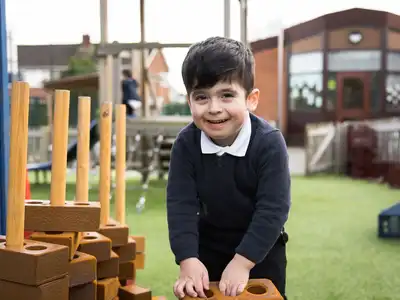

Early years learning environments need to connect to the curriculum and children’s needs. Expert early years practitioners Dixie-Louise Dexter and Nicola Middleton share how they set up their space to improve attainment in physical development learning.
Why we wanted to create an intentional early years classroom
Having fallen into the trap of setting up spaces that look appealing but lack purpose, we realised that this approach doesn’t lead to the progressive, deep learning we want for children at Ashby Hill Top Primary School. We want to create a learning environment that has the right resources and experiences to help children get the skills and knowledge they need.
Ultimately, the environment must support all children to achieve good outcomes in each of the seven areas of learning in the early years foundation stage statutory framework.
When we looked at our data, we noticed that attainment in physical development was lower than in the other prime areas so we considered how we could use our learning environment to improve outcomes.
This case study is part of a series exploring the four overarching principles of the early years foundation stage: the unique child, positive relationships, enabling environments, and learning and development.
How we decided what to change in our early years classroom
Our environment already offered the basic physical development opportunities found in most early years classrooms, such as sand, construction and fine motor areas. But these alone weren’t giving us the results we wanted. We knew we had to do something different.
We researched two key areas:
- The science of physical development: How and when do young children’s bodies develop? Which muscles need strengthening for better body control? What movement patterns must be developed first to enable progress?
- Developmentally appropriate best practice: What approaches most effectively support physical development?
This research helped us to create a progressive framework of experiences aligned with children’s natural growth and development.

How we created an intentional early years classroom to improve physical development
Some of the changes we made based on our research were:
1. Overhauling our sand area
Rethinking our sand area offered a wider range of physical experiences:
- Indoors: We made small-scale wet and dry sand available inside, both of which bring their own unique advantages and learning opportunities.
- Outdoors: We introduced large-scale sand play to support gross motor skills, upper body strength, coordination and balance.
2. Introducing a stepladder into the Doodle Den
Adding a stepladder to the Doodle Den enabled vertical mark-making using wallpaper rolls hung on the wall. This encourages full-body movement and engagement to strengthen children’s core muscles, balance and ability to cross the midline – moving across the centre of the body, which supports later control in writing.
3. Developing a sewing area
Adding a sewing area based on the Froebel Trust’s educational research on physical development helped us to understand fine motor skills acquisition. This means children can learn a new skill in a sustainable way, while promoting stillness and wellbeing. This not only improves children’s physical development, it also supports their holistic development. We taught children how to safely use a needle to sew a running stitch and when they achieved this, we developed a sewing area within our continuous provision offer.
We also temporarily enhance areas in a way that is linked to children’s interests or current learning. This enriches their learning by giving them a new way of thinking and different focus in the area. For example, we introduced a trail of tiny shoes alongside a copy of ‘The Elves and the Shoemaker’ and barefooted dolls in our sewing area – linking to our ‘traditional tale’ focus for the half term.
Making these changes part of our provision means children can revisit, rehearse and refine their skills. One-off experiences don’t have the same impact. Continuous provision is available each day of the year without changing so that children can rehearse and further extend play to build the foundational learning essential in the early years. These carefully chosen and organised resources are the backbone of our learning environment.
The right decisions at the right time led to improved outcomes
Our targeted approach to improving physical development through the environment had a significant impact:
- Gross Motor Early Learning Goal: the number of children meeting the goal increased from 90% to 98%.
- Fine Motor Early Learning Goal: the number of children meeting the goal increased from 88% to 96%.
The benefits extend far beyond data too. Opportunities for risky play have also enhanced children’s personal, social, and emotional development, while preparing their whole bodies for the physical challenges that writing brings.
Making decisions with clear purpose and progression in mind has not only improved outcomes but also created an environment where all children can succeed.
Think about your lowest attaining area of learning. How could your environment better support the development of the necessary skills and knowledge? By observing how children engage with your current provision you can identify the missing pieces and make every resource serve a purpose.