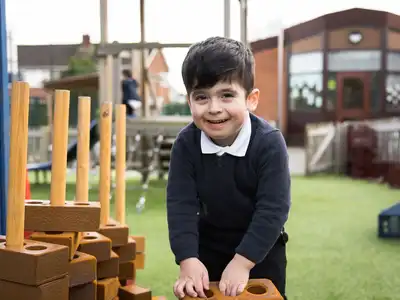

Starting school is a key milestone for children and families. Expert early years practitioners Dixie-Louise Dexter and Nicola Middleton share how strong relationships with families, pre-schools, professionals and the wider school help smooth transitions.
Children enter school with a range of experiences, starting points and needs. To help children feel happy and confident, staff need time to discover what each child brings with them. The question for us is: how can we help every child settle in, feel valued and start their school journey with a sense of belonging?
At Ashby Hill Top Primary School, our transition process begins early and involves several layers of support. It takes time, teamwork and thoughtful planning, but our experience shows that collaboration is essential. By working closely with families, pre-schools and professionals, we help children feel secure and ready for their new start. We know these first experiences matter, and we are committed to getting them right.
This case study is part of a series exploring the four overarching principles of the early years foundation stage: the unique child, positive relationships, enabling environments, and learning and development.
Families
How we work together
Developing relationships with families and children is an essential part of our transition process.
As families begin to choose a school, we open our doors to share our ethos and principles. We hold information evenings for prospective parents and open days where they can bring their child to experience the school environment. Additionally, we offer one-to-one tours with a senior leader during the autumn term to provide personalised insight. This helps them decide whether we are the right school for them and their child.
Parents are children’s first educators and the information they hold can make the difference between a smooth or challenging transition. We share information and insights with each other at a welcome evening. This has two aims:
- To share practical information about routines, the curriculum and what their child will experience.
- To introduce staff personally so they can share information about themselves and their journey to help develop comfortable and trusting relationships with parents.
We also spend uninterrupted, quality time with each family through one-to-one meetings with them, either at their home or at school. Parents can share any concerns or sensitive information in private as well as asking any questions they may still have.
These meetings also give parents the chance to talk about their child’s interests, strengths, recent achievements or family traditions. Being welcomed into the home by families also sends a strong message to children that we are safe and trusted adults.
Read more: Starting strong: how to value the unique child in early years
How it helps transition
The importance of collaboration with parents cannot be overstated. A child can only be fully supported when families and schools work together in an open, honest and trusting relationship. Beginning that partnership during transition ensures shared understanding and aligned expectations before the first day of school.
Pre-schools
How we work together
Strong relationships with feeder pre-schools are essential for a successful transition. We develop partnerships over several years and we communicate with them regularly, not just during the summer term. This gives us a rich understanding of how children’s learning develops as they transfer from pre-school to school.
As soon as we get our new cohort list, we phone each pre-school. This early communication means we can get crucial information about additional needs, safeguarding and medical requirements, with consent and in confidence, so we can put any necessary support, training or procedures in place.
Next, we visit all pre-schools and observe the children in a setting where they are comfortable and have trusting relationships with staff. This gives us a good idea of how they will respond to school life. We also have a private chat with keyworkers to learn about the child’s interests, learning preferences, strengths, challenges and strategies for emotional support.
How it helps transition
Pre-school practitioners give us valuable insight into children’s learning and emotional development that might otherwise take weeks for us to uncover. This means we can continue whatever support the child is getting seamlessly. Their understanding of the child’s home life helps build a fuller picture of their experiences too.
In return, we share information to help pre-schools prepare children for their next steps. Over time, these relationships have developed into genuine, ongoing partnerships that benefit children moving between settings.

Other professionals
How we work together
Recently we’ve expanded our approach to include other professionals working with the child, such as speech and language therapists, inclusion practitioners, pre-school SENCOs, or medical specialists. Having the time to learn from them and their knowledge of the child has been highly beneficial for us and the children. We do this through email, phone calls or occasionally joint visits during transition sessions.
How it helps transition
Early collaboration with other professionals enables us to draw on specialist expertise and put the right support in place from the outset. Strong relationships with outside agencies mean we can seek guidance whenever it’s needed.
School team
How we work together
It’s not only early years teachers who need this information. All staff who interact with the children play an important role.
Within the early years team, we share all the information we get so that everybody understands each child and how best to support them. We dedicate time for staff to meet and have meaningful discussions about the incoming cohort. And we share information with teaching staff, lunchtime supervisors and playtime support staff too.
Senior leaders meet with early years teachers to discuss the needs of the cohort and plan for any adjustments in staffing, training or support across the school.
How it helps transition
A shared understanding across the whole staff team ensures continuity of approach and helps every child feel secure and supported as they begin school life.
How our approach helps us give children the best start
Collaborating with families, pre-schools and professionals ensures that the unique child remains at the heart of what we do.
By gathering all this information before the summer break, staff have time to reflect and act. This might involve adapting the environment, routines or teaching approaches, or offering additional support for specific children and families.
Some children benefit from extra transition sessions before or after the summer holiday. It also means we have time to give families practical support like buying uniforms, helping them complete forms or arranging additional meetings for anxious parents.
Our comprehensive induction process is time-intensive and presents challenges for both teachers and leaders. However, the benefits are clear. This deep level of collaboration between families, professionals, and the school community creates the foundation for successful transitions.
Questions to help you put these ideas into practice
- How does your setting view the induction process as a way for the children to get to know the school, for the school to get to know the children, or both?
- How does your early years team find time and space to carry out a thorough induction process?
- How do you use any information you get to shape practice?