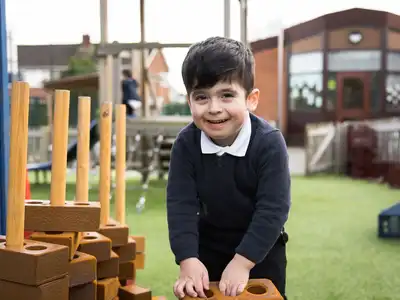
The principle of ‘enabling environments’ in the early years is about how you intentionally use your space to support children’s learning and development. This article answers: what should your early years environment actually enable for children?
Drawing on research and practical examples, this article sets out the key conditions that help every child thrive, with prompts to help you reflect on and develop your own setting. Learn more about what an enabling environment is and why it matters.
This article is part of a series exploring the four overarching principles of the early years foundation stage: the unique child, positive relationships, enabling environments, and learning and development.
Seven conditions your early years environment should enable for children
Before you evaluate or develop your environment, ask yourself: what must our early years environment enable if children are to thrive?
1. Emotional security
Longitudinal evidence from the Effective Provision of Pre-School Education study (Sylva et al., 2004) found that settings characterised by warm, responsive relationships and positive emotional environments were associated with stronger social development and fewer behavioural difficulties.
When children feel emotionally secure, their attention improves, they explore more and they are more engaged in learning.
Predictable routines, consistent transitions and clear organisation support emotional security too. This stability reduces uncertainty and cognitive load and means children can focus on learning rather than managing unpredictability.
In practice, an enabling environment should enable children to:
- Feel physically and emotionally safe.
- Form secure relationships with familiar adults.
- Experience consistent routines and transitions.
- Navigate clearly organised spaces with confidence.
Staff reflection questions:
- How quickly and confidently do children settle and begin purposeful activity?
- In what ways do our transitions help to maintain calm and continuity for children?
- How do children navigate the environment independently, and what supports or hinders their independence?
- When children become dysregulated, how consistently do adults help children to manage their emotions and behaviour by providing calm, supportive guidance?
2. Independence
Birth to 5 Matters non-statutory guidance (Early Education, 2021) emphasises that children are active agents in their learning. This means they have the capacity to make choices, initiate activities and act intentionally within their environment.
Evidence synthesised by the Education Endowment Foundation (EEF) highlights the importance of self-regulation and metacognitive development in early childhood (2021).
Self-regulation is the ability for children to manage their emotions, attention and behaviour. Metacognitive development refers to their growing awareness of their own thinking and learning processes.
Together, these skills help children become more independent, confident and motivated to learn.
In practice, an enabling environment should enable children to:
- Access materials without unnecessary adult intervention.
- Make meaningful choices.
- Initiate and sustain self-directed activity.
- Return to and build upon previous experiences.
Staff reflection questions:
- How often do children initiate activity without adult direction?
- Where are adults unintentionally creating dependency?
- How do children return to unfinished learning across the day or week, and what factors influence this?
3. Sustained thinking
The effective provision of pre-school education study identified sustained shared thinking as a key feature of high-quality settings associated with stronger intellectual outcomes (Sylva et al., 2004). Sustained thinking involves children concentrating for an extended time to develop, test and refine ideas.
Children’s attention is central to sustained thinking. Fragmented routines, interruption or excessive noise can disrupt sustained engagement, and children may struggle to stay with ideas long enough to develop them.
In practice, an enabling environment should enable:
- Concentration without unnecessary interruption.
- Repetition and rehearsal.
- Extended episodes of play.
- Opportunities to revisit key ideas over time.
Staff reflection questions:
- How do we provide children with sufficient uninterrupted time to develop and extend their ideas?
- Do we see evidence of sustained concentration, or frequent surface-level switching?
- What might be unnecessarily interrupting children’s attention?

4. Communication
Early oral language is one of the strongest predictors of later literacy and attainment. The EEF (2021) emphasises that high-quality adult-child interaction is central to improving language outcomes.
Environment shapes the conditions in which talk can happen. How the space is organised, acoustic conditions and where adults are positioned influence whether sustained dialogue is possible.
In practice, an enabling environment should enable:
- Sustained back-and-forth conversation.
- Shared attention and joint engagement.
- Narrative play and storytelling.
- Small-group interaction.
- Reduced unnecessary background noise.
Staff reflection questions:
- In what ways does the environment create protected spaces for talk, and how could this be improved?
- How do adults create opportunities for meaningful interaction with children throughout the day?
- How does the sound environment support or hinder listening and dialogue?
- Where and when do the richest conversations happen, and why?
5. Self-regulation
Executive function is a range of mental skills that help children manage their thoughts, actions and emotions. These skills include working memory (holding and using information), inhibitory control (pausing before acting) and cognitive flexibility (switching between tasks or ideas).
Research shows that strong executive function is closely linked to later academic success. Evidence synthesised by the EEF suggests that early opportunities to practise regulation and planning support children’s long-term outcomes (EEF, 2021).
Developing these skills in early childhood lays the foundation for self-regulation. While independence is about initiation, self-regulation is about enabling children to manage their attention, emotion and behaviour in pursuit of goals.
The physical organisation of space plays an important role. When children know where resources belong, how areas are used and what is expected of them, they spend less cognitive effort navigating the environment. Clear pathways, accessible resources and consistent routines allow children to direct attention toward learning.
In practice, an enabling environment should enable:
- Consistent routines and expectations.
- Manageable levels of challenge.
- Opportunities to plan and follow through.
- Protection from excessive cognitive overload.
Staff reflection questions:
- How do children have opportunities to practise waiting, planning and managing their behaviour with adult support?
- In what ways do routines provide stability without over-directing behaviour?
- How does the environment balance removing barriers with providing appropriate scaffolding for challenge?
6. Physical development
Physical development is one of the three core areas of learning in the early years foundation stage, and it’s recognised as foundational to later learning. It contributes to coordination, confidence and engagement. Opportunities for active movement and appropriate challenge support children’s motor competence and aspects of self-regulation.
In practice, an enabling environment, including outdoors, should enable:
- Gross and fine motor challenge.
- Balance and coordination.
- Opportunities to assess and manage risk.
- Physical confidence.
Birth to 5 Matters advocates a risk-benefit approach rather than risk avoidance. It recognises that children develop competence, confidence and judgement through supported exposure to manageable challenge.
Staff reflection questions:
- How is our environment safely challenging for all children?
- How are children supported to assess risk, and what impact does this have on their development?
- How do we support all children, including those less confident, to access physical challenge?
Case Study: How we created an intentional early years classroom to improve physical development
Find out how practitioners at Ashby Hill Top Primary School set up their environment to improve attainment in the physical development area of learning in this case study.
7. Inclusion
High-quality early education leads to stronger outcomes for disadvantaged children when the quality of interactions and experiences within the setting is strong. The study of early education and development findings indicate that high-quality provision can help narrow developmental gaps, particularly for children from disadvantaged backgrounds (Melhuish et al., 2017).
The early years environment must be one where all children can take part meaningfully. This extends beyond the classroom walls. Relationships with families and recognition of children’s cultural and home experiences support belonging and participation too.
For example, practitioners might display books and resources that reflect the languages and cultures of the children in their setting or adapt activities so that children with sensory differences can participate comfortably. These approaches help every child feel seen and valued.
In practice, this includes:
- Physical accessibility so all children can navigate and participate.
- Visual and communication supports.
- Spaces that accommodate sensory differences.
- Books, resources and displays that reflect the children and their families in the setting.
Staff reflection questions:
- How do all children access and participate independently, and what barriers might exist?
- How do we identify and reduce barriers to involvement for all children?
- In what ways does the environment reflect and include the children it serves?
- Whose participation is least visible, and why?
Summary
An enabling environment is not defined by its appearance, but by what it makes possible for children. By focusing on the conditions that matter most, you can create a setting where all children can participate, explore and grow. These conditions include emotional security, independence, sustained thinking, communication, self-regulation, physical development and inclusion.
Reflecting on these areas helps you make intentional choices that respond to the real needs of your children and community. Ultimately, it's these daily decisions, informed by research and shaped by your professional judgement, that make the biggest difference to children’s experiences and outcomes.
References
- Department for Education (2025). Statutory framework for the early years foundation stage: Setting the standards for learning, development and care for children from birth to five. Updated July 2025. London: DfE.
- Early Education (2021). Birth to 5 Matters: Non-statutory guidance for the Early Years Foundation Stage. London: Early Education.
- Education Endowment Foundation (2021). Preparing for Literacy: Improving communication, language and literacy in the early years. London: EEF.
- Melhuish, E., Gardiner, J. and Morris, S. (2017). Study of Early Education and Development (SEED): Impact Study on Early Education Use and Child Outcomes up to Age Three. London: Department for Education.
- Sylva, K., Melhuish, E., Sammons, P., Siraj-Blatchford, I. and Taggart, B. (2004). The Effective Provision of Pre-School Education (EPPE) Project: Final Report. London: Institute of Education, University of London / DfES.
- Sylva, K., Sammons, P., Melhuish, E., Siraj, I., Taggart, B. and Toth, K. (2014). Students’ educational and developmental outcomes at age 16: Effective Pre-School, Primary and Secondary Education (EPPSE 3–16) Project. London: Department for Education.