
Timetabling in the early years can be a difficult task. In this article, expert early years educators Dixie-Louise Dexter and Nicola Middleton share how their flexible approach to planning the school day effectively balances direct teaching and play.
Research on effective early years teaching and learning identifies three essential components of classroom practice in continuous provision: child-initiated learning, direct teaching, and guided play. All three play a vital role but balancing them effectively within a typical school timetable can be a challenge.
At Ashby Hill Top Primary School, we want children in the early years foundation stage (EYFS) to feel fully part of the wider school community. They take part in school events and share playtimes with friends and siblings. However, these whole-school routines can also create fixed points in the day, making it harder to protect longer periods of child-led learning.
So, how could we strike the right balance and create the flexibility needed for child-initiated learning while working within the constraints of a school timetable?
This case study is part of a series exploring the four overarching principles of the early years foundation stage: the unique child, positive relationships, enabling environments, and learning and development.
How we integrate the three components of effective teaching in the early years
We view the three components – child-initiated learning, direct teaching, and guided play – as interconnected learning strategies that work best when integrated and led by the children.
We removed a rigid daily timetable and adopted a more fluid approach to the day. We know what we want to happen each day – but when it happens depends on the children’s engagement and involvement in their play.
Child-initiated learning
This is at the heart of all learning in our classroom. This is where children revisit, rehearse, and refine their skills in a consistent, well-resourced environment that adapts to their needs. Our long-term plans for each area of the classroom outline curriculum links, vocabulary, and the skills children develop through play. Children need sustained periods of child-initiated play to embed what they learn. In our classroom, they spend most of their time engaged in these continuous learning opportunities.
Direct teaching
This takes place daily. Class teachers deliver learning both to the whole class and to small groups. Phonics, reading, maths, and other curriculum areas are taught directly for children to gain new knowledge and avoid misconceptions. We build three short, whole-class sessions into each day, but these are organised flexibly to suit the flow of learning. We do not interrupt children when they are deeply engaged or approaching a key learning moment simply to bring them together for whole-class teaching.
Guided play
This is what connects direct teaching with child-initiated play. This is where children make crucial learning links between what they already know and the new knowledge or skills they are developing. By regularly playing alongside children, adults can consolidate understanding, address misconceptions, provide next steps, and respond intentionally to children’s interests.
How this looks in practice
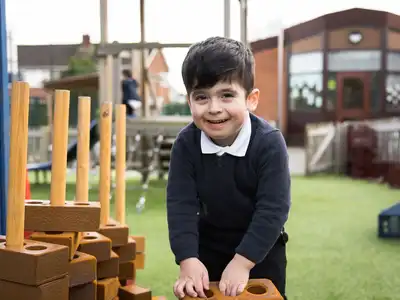
Our children developed a strong interest in building large-scale townscapes in the block area following work on mapping. As our ‘Understanding the World’ teaching (one of the seven areas of learning in the EYFS curriculum) moved to learning about London, the children spent extended periods constructing landmarks such as the Houses of Parliament and the London Eye. We enhanced the area with aerial photographs and blue fabric, and staff guided exploration of the River Thames as part of the cityscape. This allowed adults to introduce key vocabulary from our curriculum like ‘meander,’ ‘flow’ and ‘river’.
Working alongside the children, staff helped them position landmarks correctly and build an enormous London cityscape over the course of a day.
When other children joined in, an adult’s simple question – “How do cars and people cross the river?” – shifted the role from guided play to direct teaching. The adult modelled how to manipulate junk materials to create standing bridge structures, integrating ‘Expressive Arts and Design’ skills (another of the seven areas) within the learning. This opportunity for cross-curricular learning would have been missed had the adult not already been engaged in the shared, sustained thinking taking place.
In this single experience, all three elements of effective teaching – child-led learning, guided play, and direct teaching – were active. This integrated approach is the model we aim to provide every day.
How this makes learning more effective
Our more flexible day has allowed us to deepen children’s learning through sustained, uninterrupted play. Not stopping at fixed times for phonics or maths enables staff to respond to what is happening in the classroom in the moment. These sessions are delivered when there is a natural lull in children’s activity.
With the adult’s day no longer dictated by a timetable, staff can reflect more carefully on when to co-play, when to step back, and when to intervene with extensions or direct teaching. Developing this professional judgement enables staff to scaffold and facilitate learning more effectively, creating a shared learning experience between adults and children.
We encourage you to look at your own timetable and reflect on which elements could be adjusted to allow for longer periods of sustained shared play. Be intentional with your time and aim to reduce the number of transitions you and your children experience each day.