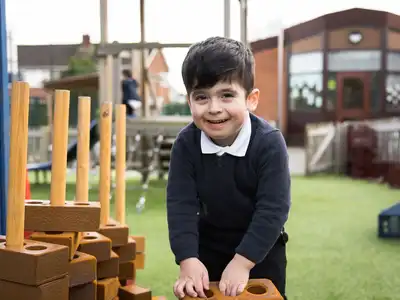
Children develop and learn in different ways and at different rates. How early years educators respond to these differences is central to the learning and development principle of the early years foundation stage statutory framework.
Drawing on research and practical examples, this article explores what the evidence says about early years pedagogy and the role of professional judgement in supporting children's learning and development. You'll also find reflection prompts to help you consider practice in your own setting.
This article is part of a series exploring the four overarching principles of the early years foundation stage: the unique child, positive relationships, enabling environments, and learning and development.
Should children learn through play or teaching?
If you spend any time talking to other early years teachers, leaders or headteachers, you'll know there are many different views about what great teaching looks like in the early years.
Should children spend most of their day learning through play? Should adults take a more active role in guiding learning? How much direct instruction is enough? And what should practitioners do while children are engaged in child-initiated activity?
These are important questions, but they don’t always have straightforward answers.
Research on effective pedagogy in the early years found that the most effective settings didn’t rely on a single teaching approach. Instead, practitioners combined child-initiated experiences with purposeful adult-guided activity, using thoughtful, high-quality interactions to extend children's thinking and learning (Siraj-Blatchford et al., 2002). More than two decades later, this remains one of the defining characteristics of high-quality early years practice.
This reflects what many experienced early years educators already know. Teaching young children is rarely about following a script. It involves making hundreds of professional decisions every day: when to observe, when to step back, when to join children's play, when to model new language, and when to introduce new knowledge through more direct teaching.
So perhaps the question is not whether children should learn through play or through teaching. Perhaps the more useful question is: what kind of teaching does this moment need?
Finding the right balance
Research consistently shows that the strongest early years classrooms don’t choose between play and teaching. They use both, recognising that each makes a different contribution to children's learning and development (Ofsted, 2024).
- Child-led learning gives children opportunities to rehearse, revisit and apply what they know.
- Adult-led teaching introduces new knowledge, models concepts precisely and secures essential foundations.
- Guided play is the bridge between child-led play and direct teaching, allowing practitioners to notice children's thinking and extend it through skilful interaction.

Making informed pedagogical decisions to teach in the moment
It's easy to think about early years teaching as a choice between learning through play and adult-led teaching. In reality, teaching in the early years is rarely this straightforward. Across a typical day in an early years setting, practitioners move fluidly between different teaching approaches, responding to children's interests, development and understanding.
The Education Endowment Foundation (2022) illustrates this through the pedagogical continuum. Rather than viewing play and teaching as competing approaches, the continuum helps us understand that effective early years practice draws on a rich repertoire of teaching strategies.
Some aspects of the curriculum, such as phonics, early reading and key mathematical concepts, are most effectively taught through explicit, carefully sequenced instruction. Other aspects are strengthened through sustained shared thinking, guided play and rich adult-child interactions. High-quality early years practice is not about favouring one approach over another. It is about understanding which teaching approach is most appropriate for the learning at hand.
Professional judgement enables you to move confidently along the continuum, selecting the right approach at the right time. This requires a deep understanding of child development, the curriculum and the children in front of you.
Case study: How we balance teaching and play to maximise learning in the early years
Expert early years practitioners, Dixie-Louise Dexter and Nicola Middleton, bring these principles to life at Ashby Hill Top Primary School. They describe how they create a more fluid day, making intentional pedagogical decisions that combine child-initiated learning, adult-led teaching and guided play to maximise children's learning.
You can read about their approach in this case study: How we balance teaching and play to maximise learning in the early years.
Leading great teaching in the early years
Leading great teaching in the early years isn't about asking practitioners to choose between play and direct teaching. It's about creating the conditions for professional judgement to flourish. Here are three questions to help you evaluate and strengthen practice in your setting.
1. Are your practitioners making intentional pedagogical decisions?
When you visit your early years classroom, look beyond what children are doing. Watch what practitioners are doing. How are adults responding to children's ideas? When do they observe, model, question or explicitly teach? The quality of practitioners’ decisions will tell you far more about the quality of teaching than the activity itself.
2. Do staff share an understanding of effective pedagogy?
Great pedagogy is underpinned by a shared understanding of child development, curriculum and evidence-informed practice. Create opportunities for practitioners to explain and reflect on why they chose a particular teaching approach, drawing on their knowledge of child development, the curriculum and individual children.
3. Does your curriculum drive pedagogical decisions?
Start with what children need to learn, then consider the teaching approach most likely to help them get there. The most effective early years educators don't begin by asking, ‘Should this be play?’ They begin by asking, ‘What do children need to learn?’
Questions for staff reflection
Research shows that leaders who intentionally create enabling conditions make professional collaboration possible and sustainable (Chartered College of Teaching, 2024). Ask yourself:
- How do you protect regular time for staff to meet, reflect and learn from each other, making collaboration a valued part of each week?
- In what ways have you built a culture of trust, where staff feel safe to share ideas, challenge thinking and try new approaches?
- How are you encouraging your team to engage with research and external networks to bring in fresh ideas and best practice?
- What do you do to value everyone’s contribution, ensuring all voices are heard and expertise is shared across the team?
Summary
Great teaching in the early years is not defined by one approach, one timetable or one philosophy. It is defined by skilled practitioners making thoughtful, evidence-informed decisions about what children need to learn and the teaching approach most likely to support their learning. That is what great teaching looks like in the early years.
References
- Department for Education (2024). Statutory Framework for the Early Years Foundation Stage.
- Education Endowment Foundation (2022). Contexts for teaching and learning: the early years pedagogical continuum
- Ofsted (2024). Best start in life part 1: setting the scene.
- Siraj-Blatchford, I., Sylva, K., Muttock, S., Gilden, R., & Bell, D. (2002). Researching Effective Pedagogy in the Early Years (DfES Research Report 356).